

The world seems even more chaotic than usual right now.
In addition to all of the problems we’ve recently seen with the nationwide airline ground stop and the high profile companies that have been hacked, we’ve also seen an increase in news about bombs.
If you missed it, an explosive device was delivered to an ethanol fuel refinery in Peoria, Illinois prompting a massive evacuation. Because the device was found in such close proximity to all that fuel, there was a blast radius of more than one mile. Everyone living and working in the affected area had to be evacuated until the device was rendered safe and the facility was cleared of any other potential explosives.
In Europe, over 6,000 schools throughout five different countries received similar bomb threats stating “We Have Come To Annihilate You.”
Smart money will bet on seeing more bomb threats than usual here in the United States in the next few weeks. Have you thought about how best to handle any potential bomb threats in public areas under your control?
Traditional response to a bomb threat in a business or school is to evacuate the area. Unless a suspicious device is actually found, evacuation is almost always a bad idea. If you are relying on evacuation after a bomb threat to keep people safe, you might actually be creating a far more dangerous scenario for the people you are trying to protect.
Let’s think about this a little more deeply…
Why would a person who has actually placed a bomb in a public area call in a threat?
The only reason he would call in the threat is if he DOESN’T want anyone to get hurt. If that’s his goal, he will be as specific and convincing as possible to get people out of the danger zone.
All of these non-specific “there’s a bomb in the building” threats are hoaxes. A legit bomb threat will sound something like: “I placed a bomb in the first floor janitor’s closet. It’s set to go off in 10 minutes or whenever the closet door is opened. Get everyone out of the building in the next 10 minutes or people will die.”
Do you see the difference between the two communications strategies?
It actually places MORE people in danger when you evacuate for every non-specific bomb threat. It is far more difficult to place a large explosive device inside a public building than it is to hide it outside in the parking lot that most buildings use as an evacuation site.
If the bomber knows you are going to evacuate, he’ll just place the bomb in the evacuation zone and call in a threat. Or even easier, he’ll call in a threat and set up on the evacuation site with a rifle to shoot all the evacuees. End result of either scenario: lots of dead people.
Do you really want all your employees/students leaving a relatively safe building and running outside into an area where it’s actually easy to hide a really large bomb?
In practice, the largest bomb that someone might reasonably place inside a public building is something the size of a backpack (about 50 pounds of explosives). If the same bomber filled the trunk of a car with explosives he could have a bomb with a payload of over 500 pounds. And then he can drive that car with the 500 pound bomb right into the parking lot where you will be evacuating from the fake bomb threat he calls into your building.
Let’s look at a bomb evacuation distance chart:
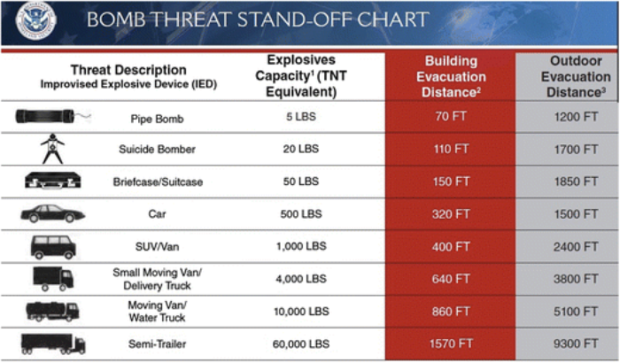
The explosion from a 50 pound backpack bomb detonated indoors only has a fatal blast radius of about 150 feet (potentially less if walls are concrete). That very same bomb placed outside (like in your evacuation area) has a fatal blast radius of 1850 feet.
A 500 pound car bomb outside can kill people out to 2400 feet away. That’s almost a half mile. Is your evacuation zone more than a half mile away from every parked vehicle? I didn’t think so.
Most intended victims are safer inside a building (even if a bomb goes off) than they would be outside in the evacuation zone.
Bottom line:
– Don’t evacuate public locations because of non-specific bomb threats. By doing so, you are actually placing the building occupants in more danger.
– Only evacuate when the bomb threat is both specific and believable or an actual suspicious package is found.
– Don’t evacuate to a parking lot where bigger bombs can be easily hidden.
– Most hand-carried bombs have a limited range inside a building. If you get a very specific threat providing the bomb location, it may be safer just to move everyone to a part of the building farthest away from the bomb rather than taking them outside.
Panicked mandatory evacuation is not the best response for a non-specific bomb threat with no visible suspicious device.