

“Keep your head on a swivel” is some of the dumbest self protection advice I’ve heard on the internet. It ranks right up there with using wasp spray for self defense, carrying car keys between your fingers, and loading your home protection shotgun with birdshot.
What does “head on a swivel” even mean?
Should you spend all your time in public looking like the girl from The Exorcist?
Nel
Let me tell you a story…
It was 17 years ago this month. I met her in Bolivia. She was an artist and photographer in her mid-20s. With a tremendous passion for travel, she had been to locations that frightened me to even think about. Her name was Nel.
She had an anthropology degree but worked in theater…only enough to fund her international adventures. Nel was a tiny human. Five feet tall and barely 100 pounds when we met. She had an infectious smile and an insatiable desire for novel experiences.
We hit it off instantly and traveled together for almost a month, engaging in the kind of intense fling that only foreign travel can spawn. We both knew that our romance wouldn’t ever lead to anything permanent, but we were happy to enjoy each other’s company so long as our forays through South America lasted.

A picture of Nel taken when she got home shortly after we met
What I first noticed about Nel was that her head was always “on a swivel.” Her personality was a simultaneous mix of being scared to death yet unstoppably eager for new experiences.
She had done everything from wild land firefighting in Africa to teaching English to children in rural Chinese villages. Despite her unquenchable thirst for adventure, she was constantly looking around with a fearful countenance.
Always trying to spot any potential criminal who viewed her as prey.
It never worked.
As I observed her mannerisms, I couldn’t help but think: “She seems almost paranoid. She should just take a deep breath and relax. Things aren’t that dangerous here.”
On a 26-hour bus ride across Brazil, she opened up and told me why she “kept her head on a swivel.” She had a childhood history of physical and sexual abuse. She had been seriously attacked and hospitalized numerous times in her extensive third world travels. She was ashamed to tell me that in the two weeks she had been traveling before we met, she had been robbed twice.
A group of men had knocked her to the ground, groped her, and ripped the necklace from her throat in broad daylight in a Bolivian town square as cops looked on without intervening. A few days later, a teenage kid hit her in the face, grabbed her handbag, and ran off.
Her constant scanning wasn’t helping her. It was marking her as someone who looked scared and would make an easy victim.
On that interminable bus trip, I gave her some self defense and awareness advice. I didn’t want to see her get robbed again. She fell asleep with her head on my shoulder as the overnight bus struggled through the dark mountain passes. When she woke up, she told me that sleeping next to me was the first time she had felt truly safe in years.
Even though we talked about how her “head on a swivel” actions were marking her as a victim, she couldn’t stop obsessively scanning. Later in the trip, we split up for the day. She wanted to do some shopping and I wanted to take a Brazilian Capoeira fighting lesson. While she shopped, a man knocked her down and stole her camera.
Despite her “head on a swivel” she was robbed three times in less than a month.
The Alternative
“Keeping your head on a swivel” IS NOT situational awareness. In fact, I would argue that constant repetitive scanning makes you look paranoid and scared. That’s how prey behave. That’s why my friend Nel got jacked over and over again. I think “keeping your head on a swivel” makes you more likely to be attacked.
Who obsessively looks around like that in public places?
– Scared people
– People who are alone
– Drug dealers looking to avoid robbery and police
– Human trafficking victims frightened about rape/retaliation from pimps or “clients.”
– Hardcore drug users looking for their next score
– People who are hiding from the police
The folks who fit all those categories make the best crime victims. Do you want to look like them?
In the article Situational Awareness, Lawdog makes the point that:
“Scanning for danger” means you’re looking for things that are already a threat — and only looking for active threats puts you way behind the power curve.”
If you only detect the threat immediately before the attack commences, you are too late.
As Lawdog states in the article, proper situational awareness involves establishing a baseline of behavior and then noticing anomalies in that baseline.

The baseline of behavior on Ipanema beach in Rio de Janeiro is very different from that of a country feed store in Iowa or a ghetto street corner in Chicago.
We fail at situational awareness not because we aren’t scanning enough for immediate threats. We fail when we don’t take the time to look around the environment and establish the correct baseline. We assume all anomalies will obviously stand out. It doesn’t work that way.
The only way we can detect an anomaly is if we understand what is different from the baseline.
When we notice those differences, we have time to act, get away, evaluate further, or call for assistance.
Spotting the attacker with the rifle in his hand as he commences shooting doesn’t give us much time to respond. Spotting the guy wearing the heavy trench coat in July to hide that rifle as he maneuvers into attack position gives us far more options.
Spot the anomaly early enough and you’ll identify the attack while you still have time to act.
Lots of you likely scan your surroundings while asking yourselves “what is out of place here?” But how many of you scan your environment and ask “What does ‘normal’ look like around here?” It’s only by identifying the “normal” that you will be able to properly identify the anomaly.
If you want some more information about assessing baseline behaviors, start by deeply reading the article from The Lawdog Files that I linked above. Then check out my article on Parking Lot Precautions where I talk about my personal processes for establishing baselines.
If that piques your curiosity, the next step is reading the book Left of Bang, where the authors first quantified the need for baseline assessments. Then listen to this episode of the Human Behavior podcast where the trainer who developed the concepts presented in Left of Bang goes for a deeper dive into the subject.

I wish I could tell you that I was able to teach Nel how to better avoid the bad guys.
I never saw her again after our brief travels in South America. We shared occasional texts and messages in the following years. We talked about meeting up again, but neither of us ever made it enough of a priority to make it happen.
The last message she shared on her Facebook page was this:
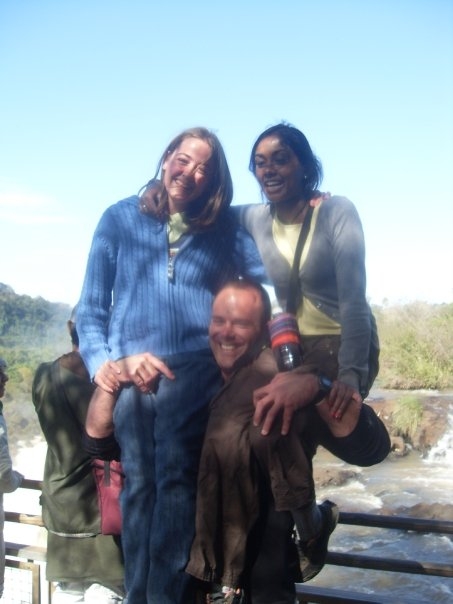
It’s difficult for me to keep my head on a swivel with a woman on each shoulder.
Nel is on my right shoulder as I boost the ladies up to get a better view of the Iguassu Falls on the Brazil/Argentina border.