
Written by: Greg Ellifritz
Take a moment to imagine one of the following scenarios:
– While stopped in traffic at an inner-city intersection, a man with a gun approaches you. He begins striking your closed window with the weapon, demanding that you give him your car. You fear that if you get out and comply with the criminal’s demands he may drive away with your two small children who are strapped into their child seats in the back of the car.
– You are a customer in a bank during a “takeover” style robbery. After obtaining all of the money from the bank drawers, the robbers begin systematically searching each customer for valuables. As soon as each patron’s money is taken, he or she is quickly shot in the back of the head. You are next in line.
– You are a young woman out on a first date with a man you have just met. The man begins to get violent and tells you he has a firearm in his coat pocket. He orders you to take off all of your clothing. He tells you that after he is done raping you, he plans to kill you so that you will not be able to identify him to the police.
While the above-listed scenarios are not the most common types of criminal acts, we must be prepared for anything to happen. If you found yourself in one of these dangerous situations, what would you do? The commonly espoused tactic of compliance with the criminal’s demands “so that you won’t be hurt” may not be a very effective option in situations like these.
Most “experts” and police authorities advise crime victims to never resist their attackers under any circumstance. This type of blanket advice is at best misleading and at worst, life threatening. No one knows your abilities, your fears, your motivations, and your situation better than you do. That means that no one should presume to tell you what you should do in any given situation. There are just too many variables involved. Although the decision to resist an attacker is a complicated one, examining the relevant academic research will provide some guidance. Let’s take a look at some of the issues…
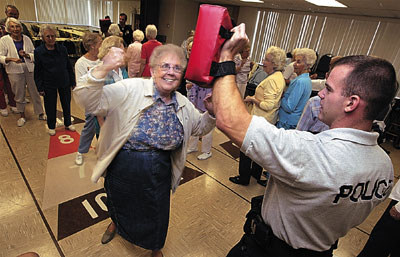
Physical resistance training shouldn’t be limited to the young and athletic.
Does your attacker have a weapon?
It is clear that criminals carrying deadly weapons pose a serious threat to the average citizen. Fortunately, research from the U.S. Department of Justice indicates that only twenty-six percent of all violent crimes (homicide, rape, sexual assault, robbery, and assault) were committed by offenders armed with some type of weapon. Ten percent of violent crimes involved the use of a firearm. Only eight percent of rapes are committed by armed attackers (1).
It has been my experience that many crime victims choose not to resist a violent attacker out of fears that the attacker may be armed. While this is certainly a valid concern, the facts show that the majority of violent criminals do not use weapons in the commission of their crimes! If any assumptions are made, it should be assumed that the criminal is not armed unless there is evidence to the contrary.
If your attacker is armed with a gun, is it real and does it work?
This topic is rarely addressed in crime prevention literature. It leads to the conclusion that it is hopeless to resist and armed attacker, because you will certainly be shot. It is undoubtedly a very dangerous proposition to resist any attacker armed with a firearm, but there are several facts that may mitigate some of the danger.
Criminals do not generally carry the highest quality firearms available. Most criminals are committing crimes to fuel their drug, alcohol, or gambling habits (2). Those activities consume a large amount of cash. A crack cocaine addiction doesn’t generally leave a surplus of money to purchase high quality firearms, even if they are “tools of the trade”. If criminals do manage to acquire (read: “steal”) a quality firearm, it is often sold quickly to get some money to buy more drugs. Oftentimes, even if a criminal is in possession of a functioning firearm, he or she cannot afford to buy ammunition to load it.
Several statistics prove this point. One author states that thirty percent of robberies are committed with unloaded guns. An additional ten to fifteen percent of the firearms used in crimes are replica, toy, or BB guns (3). One study from 1990 on criminal use of toy guns in urban environments indicated that 15% of armed robbers used toy guns or air guns in the commission of their crimes. That means that almost half of the guns used in crimes are unloaded or fake!
Many other firearms used in crimes are broken or non-functional. In a study of weapons seized from criminals by my police department, 13% of the seized firearms were non-functional. We commonly encounter weapons with broken firing mechanisms, weapons loaded with the wrong magazines or ammunition of the wrong caliber, and weapons clogged with grease or debris. To mirror the earlier referenced study, an additional 28% of the weapons seized from criminals by my department during the last few years have been unloaded. Combine the broken guns with the unloaded ones and you will see that 41% of the actual guns seized from criminals wouldn’t work!
If your attacker does have a weapon, will he use it?
Even if an attacker is armed with a functioning, loaded firearm, he is often reluctant to use it. Criminals fear getting caught by the police and know that gunshots are surefire ways of attracting police attention. Those criminals whose brains aren’t too clouded by alcohol or drugs may also be cognizant of the fact that they are likely to serve a longer prison sentence if they injure or kill another person in the course of their crime. Overall, fewer than one percent of violent crimes result in a gunshot injury. Most often, criminals use a firearm as a blunt object, striking the victim with it instead of shooting (4). Even if you evaluate only violent crimes committed by attackers armed with a firearm, only 4.6% of victims were actually shot (5).
Criminals armed with knives and clubs were far more likely to use the weapons to inflict injury to their victims. Club assaults resulted in injury 36% of the time (most injuries were minor, however). Knife armed attackers cut or stabbed their victims in 12.7% of violent crimes (6).
If the attacker shoots at me, how likely is it that I will be hit?
Historically, even trained police officers do poorly when shooting during life-threatening situations. Depending on the study, police hit rates range from 10- 23%. Most authorities believe that criminals shooting at their victims do even worse. Some criminals do not even try to injure someone when they fire their guns. Research by James D. Wright and Peter H. Rossi illustrates this fact. In an interview with 184 felons imprisoned for using a firearm during the course of a crime, 40% of the felons said they fired their guns to “scare the victim” or “to get away”. Only 34% stated that they shot to “injure” or “kill” the victim (7).
During the 1970s, the New York City Police Department studied some 6,000 police gunfights. It even though the study is more than 30 years old, it remains one of the largest of its type ever completed. The NYPD study showed that criminals shooting at police officers only hit with 11% of the rounds they fired (27).
The U.S Department of Justice estimate that victims received gunshot wounds in only about 3% of nonfatal violent crimes involving the use of a firearm (8). Another study of nearly 200,000 state inmates reports that only 30% of all inmates who discharged firearms in the course of their crimes injured or killed their intended victims. Not all of those injuries or deaths were related to gunshot wounds, however. On the basis of these two studies, we can safely assume that if a criminal fires a gun at you during the course of a crime (even if he fires multiple times) he will only hit you between 3% and 30% of the time (9).
If I do get shot or stabbed, am I likely to die?
Real life gunshot wounds seldom look like they do on television or in the movies. People who are shot do not generally fly backward under the force or the bullet’s impact. Often they do not even fall down. Depending on the type of weapon involved, bullet wounds usually result in a small hole with a little blood. Thanks to modern medical technology, shooting victims survive a vast majority of wounds. In fact 92% of victims hospitalized for a firearms injury are discharged from the hospital alive. Forty-seven percent of victims of gunshot wounds are treated and released without an overnight stay! These statistics are partially due to good medical care and partially the result of poor shooting on behalf of the criminals. Almost half of the victims shot during a criminal assault were wounded in the extremities (hand, arm, foot, or leg) only (10).
Overall, firearms assaults have a lethality rate of 5.4%. Knife assaults kill victims in 1.1% of cases. These statistics can be compared with a .06% lethality rate for assaults using bodily weapons (hands, feet, etc) (11).
Am I more likely to be hurt or killed if I resist a criminal attacker?
The research is contradictory on this question. The short answer is that it depends on the type of crime and what method the victim uses to resist. Resistance to crimes of violence is more common than most people realize. Overall 71.4% of victims of violent crime took some type of self-protective measure. Such measures include screaming, running, physically fighting the attacker, and using a weapon, among other things (12). Resisting a crime by using a firearm generally reduces your chance of being hurt or killed, especially for women. A study by Gary Kleck found that the probability of serious injury in a criminal attack is two and a half times greater for women offering no resistance than women resisting with a firearm. Men are also safer if they resist with a firearm than if they do not resist at all, but the difference is smaller (1.5 times less likely to be injured) (13).
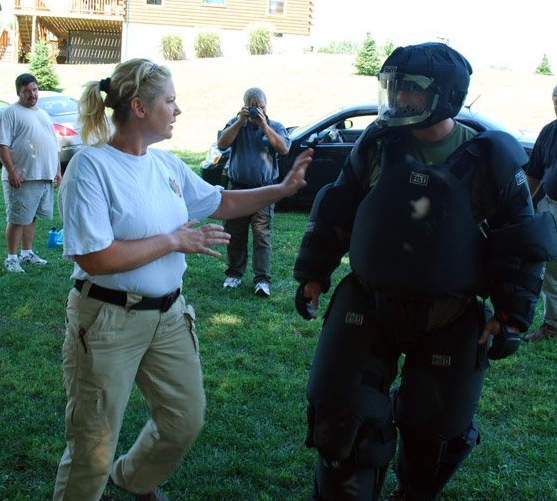
Resistance training should include full contact scenarios integrating weapons. Note folding training knife in this student’s pocket.
Unarmed resistance, on the other hand, does positively correlate with an increased rate of injury in most crimes. One study showed that, during a retail robbery, unarmed resisting store clerks were 50 times more likely to be killed than clerks who did not resist (14). Victims resisting robberies are 20% more likely to be injured than victims who comply with the robbers’ demands. Eighty-six percent of resisting victims are injured as compared to sixty-six percent of compliant victims (15). Presence of a weapon by the criminal does not influence injury rates. Injury rates are the same between victims attacked with weapons and victims attacked by unarmed criminals (26%), although victims attacked by armed criminals were about 3.5 times more likely to suffer serious injuries (16).
Researcher David Luckenbill found that if a victim resisted a robber, the robber was just as likely to abandon the scene without further action as to apply force (26).
Studies dealing with the crimes of rape or sexual assault on women are extremely contradictory. Almost all studies indicate that women who resist sexual assault are more likely to be injured (beyond act of rape itself) than women who do not resist (17). When you include the rape act itself as an injury, however, the difference in injury rates between compliant victims and resisting victims is only about 10% (18). This is partially due to the fact that resisting victims are less likely to be raped than passive victims. I will discuss this aspect in more detail later in the paper.
A few studies shed even more detail on resistance during the crime of rape and assaults against women. One meta-analysis, controlling for type of resistance, victim/offender relationships, location, and demographic characteristics, reports that women were least likely to be injured in assaults if they employed some non-physical (arguing, screaming, threatening to call police, etc.) method of resistance. Non-physically resisting victims suffered fewer injuries than women who either physically resisted or complied with their attackers (19). Additionally, specific to the crime of rape, amount of resistance is not correlated to amount of injury. There is also no correlation between presence of a weapon and amount of injury in rape cases (20).
It is important to note that, when examining statistics on resistance, a positive correlation between resistance and injury does not necessarily imply that the resistance caused the offender to injure the victim. Stated another way, victims may choose to resist as a result of being injured. In fact, some research indicates that the majority (79%) of women injured in a sexual assault were harmed before the assault took place (21). This study and others may imply that use of force by the criminal may act as a stimulus for the victim’s resistance. Furthermore, the majority of injuries occurring during any crime are minor, (cuts, scrapes, bruises, and contusions). With regards to the crime of rape, only 7.7% of the victims suffered a serious injury other than the rape itself (22). One must analyze resistance statistics very carefully.

If you are going to resist, use the best techniques available. Here, the author teaches a throat rip technique during a senior citizen’s self defense class
Is resistance an effective strategy for preventing crime?
Almost all studies show that resistance is successful in preventing the completion of a personal crime. This holds true in rape, robbery, and assault (23). Resistance is an especially effective tactic in preventing most rapes. A woman who physically resists a rapist doubles her chance of escaping rape (24).
One study correlated the victim’s success in avoiding rape during an attack with the methods she used to resist:
– Victims crying or pleading were raped 96% of the time
– Victims who loudly screamed were raped between 44% and 50% of the time
– Victims who ran were raped 15% of the time
– Victims who forcefully resisted (without a weapon) were raped 14% of the time
– Women who resisted with knives or guns were raped less than 1% of the time
Another study asked resisting victims of violent crimes whether their resistance helped or hurt their situations. The responding victims overwhelmingly stated that resistance helped them in the majority (63%) of cases. This statistic holds true for all of the crimes examined (rape, robbery, and assault). Resistance only hurt their situations about 9% of the time (25).
Conclusion
I can’t tell you exactly what to do if you are confronted by a criminal. I can tell you that, based on the research, police departments should not be telling crime victims to “never resist” their attackers. Resistance is often a viable and successful strategy.
My best advice is to urge you to think about possible attacks BEFORE they happen. Plan a response in advance so you don’t have to think through your options during the stress of the incident. Trust your instincts and make the best decisions you can. I hope this literature review gives you a little more confidence in whatever decision you make.
ENDNOTES
1) U.S. Department of Justice, Bureau of Justice Statistics. “Weapon Use and Violent Crime”, September 2003.. NCJ 194820.
2) Wright, Richard T, and Decker, Scott H. Armed Robbers in Action. Northeast University Press. 1997. Pg. 97.
3) Hockheim, Hock, Unarmed Versus The Knife. Lauric Press. 2001.
4) U.S. Department of Justice, Bureau of Justice Statistics. “Weapon Use and Violent Crime”, September 2003. NCJ 194820.
5) U.S. Department of Justice, Bureau of Justice Statistics. “Weapon Use and Violent Crime”, September 2003.. NCJ 194820.
6) U.S. Department of Justice, Bureau of Justice Statistics. “Weapon Use and Violent Crime”, September 2003.. NCJ 194820.
7) Wright, James D. and Rossi, Peter H. Armed and Considered Dangerous, Aldine de Gruyter, 1986.
8) U.S Department of Justice, Bureau of Justice Statistics. “Firearm Injury and Death from Crime, 1993-1997”. November 2001. NCJ 182993.
9) U.S Department of Justice, Bureau of Justice Statistics. “Firearm Use by Offenders”. October 2000. NCJ 189369.
10) U.S Department of Justice, Bureau of Justice Statistics. “Firearm Injury and Death from Crime, 1993-1997”. November 2001. NCJ 182993
11) Harris, Thomas, Fisher, and Hirsh. “Murder and Medicine: The Lethality of Criminal Assault 1960-1999”. 2001.
12) U.S Department of Justice, Bureau of Justice Statistics, ““Criminal Victimization in the United States, 1999 Statistical Tables”, NCJ 184938, Table 68.
13) Lott, John R. More Guns Less Crime. University of Chicago Press. 2000. Pp 3-4.
14) Caparatta, Paul. Merchants at War. Varro Press. 1998. Pp. 24-25.
15) Campbell, Anne. Men, Women, and Aggression. Basic Books. 1993. Pg. 102.
16) U.S. Department of Justice, Bureau of Justice Statistics. “Weapon Use and Violent Crime”, September 2003. NCJ 194820.
17) Bachman, Saltzman, Thompson, and Carmody, “Disentangling the Effects of Self-Protective Behaviors on the Risk of Injury in Assaults Against Women”. Journal of Quantitative Criminology, Vol. 18, No 2, June 2002.
18) Ghiglieri, Michael P. The Dark Side of Man. Perseus Books. 1999.
19) Bachman, Saltzman, Thompson, and Carmody, “Disentangling the Effects of Self-Protective Behaviors on the Risk of Injury in Assaults Against Women”. Journal of Quantitative Criminology, Vol. 18, No 2, June 2002
20) Michaud and Hazelwood. The Evil That Men Do. St. Martins True Crime. 1999.
21) Siegel, Sorenson, Golding, Burnham, and Stein. “Resistance to Sexual Assault: Who Resists and What Happens?” American Journal of Public Health, Vol. 79, No. 1, January 1989.
22) Kleck and Sayles. “Rape and Resistance” Social Problems. Vol. 37. No. 2. 1990.
23) Bachman, Saltzman, Thompson, and Carmody, “Disentangling the Effects of Self-Protective Behaviors on the Risk of Injury in Assaults Against Women”. Journal of Quantitative Criminology, Vol. 18, No 2, June 2002
24) Ghiglieri, Michael P. The Dark Side of Man. Perseus Books. 1999
25) U.S Department of Justice, Bureau of Justice Statistics, “Criminal Victimization in the United States, 1999 Statistical Tables”, NCJ 184938, Table 72.
26) Katz, Jack. Seductions of Crime. 1988. Page 180.
27) Kane and Wilder. The Little Black Book of Violence. YMAA Publication Center. 2009. Page 217.