
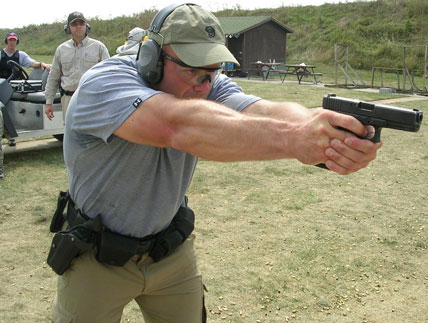
Running my Glock 21 hard at one of Henk Iverson’s classes. A rear frame rail broke off soon after the class. The whole gun was replaced by Glock. It only had 32,000 rounds through it.
OK, let me get this out of the way right off the bat. I carry a Glock pistol during about 95% of my waking hours. My police duty gun was either a Glock 21 or a Glock 17. A Glock 26 or a Glock 19 in 9mm are constant companions in my off-duty hours. I like Glock pistols. But are they perfect? Not a chance.
I’ve broken almost every Glock I’ve ever owned. No manufacturer is immune from this reality: If you shoot the gun enough, it will break. A gun is a mechanical device and it can fail at any time. I liken it to a car. Even if you buy the best car in the world, eventually it will break down.
I’ve been a factory-certified Glock armorer since 1997. In my job as training officer at the police department, I inspected and maintained more than 75 Glock pistols carried by my officers. I also taught at one of the largest shooting schools in the country, seeing hundreds more Glock pistols in my students’ hands each year. I’ve seen Glock pistols break in every conceivable manner. Don’t tell me “Mine has never broken!” That’s because you don’t shoot it enough. Put 10,000 rounds or more a year through a single pistol and see what happens.
Yes, they will break. But one of the reasons why I like the Glock so much is that they are easy to fix. Many of the common parts breakages can actually be prevented with some routine maintenance. In this article, I’m going to explain what parts I see break most often, and what you can do to either prevent or fix the breakages and get your gun up and running again.
#1 Most common parts breakage- Trigger Spring
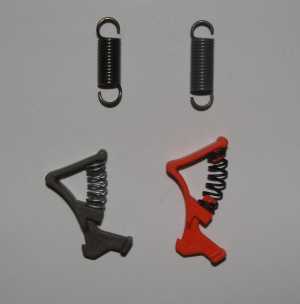
Glock Trigger springs. The coil ones on top break fairly regularly.
If you look at the picture, you’ll see the coil springs on the top row. One of those springs is in your trigger mechanism. It is what returns the trigger to the forward position after the shot. They break all of the time (right at the bend on top or bottom), but not in a predictable fashion. I’ve had some guns go more than 50,000 rounds on the original spring. I’ve also seen a spring break within the first 1000 rounds. They are unpredictable.
When they break, the gun usually still functions, especially if you hold the trigger to the rear and “catch the link” after your shot breaks. If you don’t do that, you can still manually move the trigger forward after each shot. It’s not a fight stopper, but it is a pain in the ass.
If you never want to deal with spring breakage, use one of the NY trigger springs (lower level on the picture). They compress rather than stretch and I’ve never seen one break. Unfortunately, they will raise your trigger pull weight to 8 or 12 lbs from the factory 5.5 lbs. I don’t use them for that reason.
If you want to keep a traditional coil spring in the gun, I’d replace it every 10,000 rounds or so. When you do, make sure it goes in the gun looking like an “S” shape (like the photo shows) and not backwards. If you install it backwards, the gun will work, but the spring is more likely to break.
#2 Most common parts breakage- Locking Block Pin
The locking block pin is the top one of the two pins above your trigger. It breaks fairly regularly, especially in the .40 and .357 Sig guns. You’ll know it’s broken because your gun’s slide will randomly lock to the rear when you still have rounds left in the magazine.
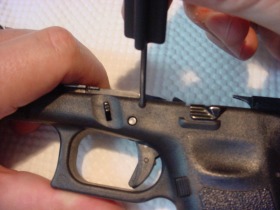
An armorer is using a punch to remove the locking block pin
The best way to stop it from breaking is to replace your recoil springs every 3000-5000 rounds. Not many Glock owners do this, but I’ve found it to be critical in avoiding parts breakage. When the recoil spring weakens, the slide moves faster and puts more stress on many of the parts on the gun (frame rails, locking block, pins). The constant high-speed battering is a sure recipe for a locking block pin breakage. Replace your recoil spring!
If your locking block pin does break, don’t just shove a new one into the hole. The slide stop lever (slide release) tensions on the locking block pin. If you drive the pin through the hole with the slide stop lever still in place, you could damage the spring on the top of the lever. Remove the trigger pin and slide stop lever. Reinstall the locking block pin. Tension the slide stop lever underneath the locking block pin and then drive in your trigger pin.
#3 Most common parts breakage- Slide Stop Lever
This one isn’t usually a breakage. Nothing actually breaks. The spring just gets all bent up and the piece stops working correctly. See the wire spring on the left of the slide stop lever (also called the slide release)? That’s what I was talking about above when I said it tensions under (not around) the locking block pin.
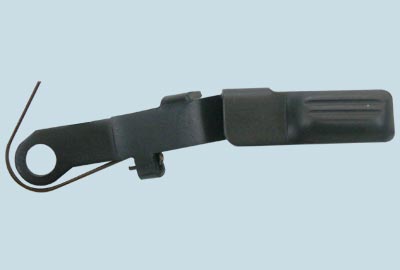
Those springs get thrashed from poor reassembly techniques and occasionally just bend through normal usage. You’ll notice something is wrong because the slide will lock open randomly when firing or it won’t lock open after the last round is fired. If this happens, just replace the slide stop lever. It’s around $5. I’ve never had any luck bending the spring back into the right position.
#4 Most common parts breakage- Slide Lock Spring
The slide lock spring is the L-shaped spring that gives tension to the slide lock, that piece that you push down in order to strip your gun.
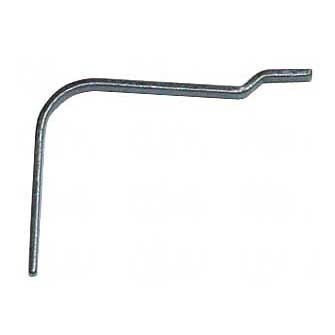
slide lock spring
When these break, it’s a fight stopping malfunction. The slide will just fall off of the frame after you fire a shot. In essence, the gun comes apart during firing just like when you take it apart for cleaning. I’ve had some bad luck with this one.
I once carried a .45acp Glock 30. I loved the gun, but the slide lock spring broke SEVEN TIMES! I had to get rid of it. It just wasn’t reliable enough to carry. I’ve seen other Glock 30s with broken slide lock springs as well.
The other guns I see with broken slide lock springs are the older (Generation 1 and 2) model 23 and 19 guns. There are 2 different slide lock springs for the Glock 23 (and 19). The newer one is thicker and less likely to break. The older one is narrow and breaks after about 8,000 rounds in my experience. If you have the narrow one, you should probably upgrade to the new one. The spring costs about $2 and can be replaced in less than 5 minutes.
No matter which Glock you carry, you can cause wear to the slide lock spring by improperly installing your recoil spring assembly. When you are setting the recoil spring down into the grooves in the barrel, make sure you place it in the DEEPEST GROOVE. Not the one closer to the surface. If you place it in the top groove, the edge of the recoil spring assembly will rub on the slide lock spring every time the slide reciprocates. That will eventually cause it to break.
I’ve seen lots of other parts break, but the ones I listed above are by far the most common. Most of them won’t really even take you out of the fight if you recognize what’s going on.
Prevention is really pretty simple…
If you own a Glock, regularly replace the recoil spring assembly (every 3000-5000 rounds), check your pins, and take a look at the springs when you take the gun apart for cleaning. That’s not too hard. If you are concerned about parts breaking during a gunfight, carry a second gun. It’s the best insurance you can buy.
Parts replacement is pretty easy. The best Glock gunsmithing reference I’ve found is The Complete Glock Reference Guide. If you aren’t mechanically inclined, this book provides excellent disassembly and repair instructions.
Are Glocks perfect? Nope. But most other guns are even less so. I’ll keep carrying my Glock “perfection” until another gun maker creates something better. I’m not holding my breath.
Yes, that’s an airsoft Glock. I had to use it to demo a building search technique when its big brother (holstered) stopped working.